

Quick Answer
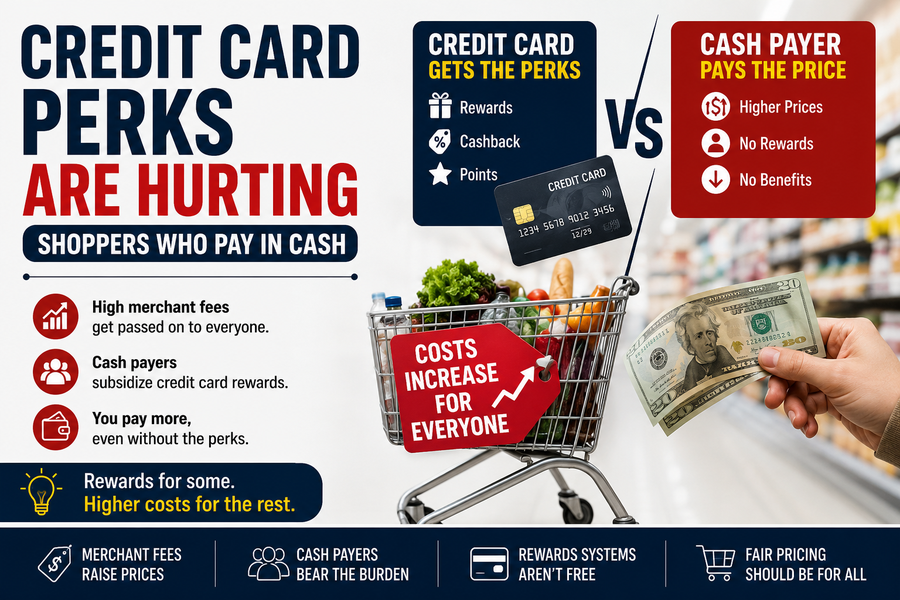
Credit card rewards programs create a hidden wealth transfer: merchants raise prices to cover interchange fees charged by card networks, and those higher prices are paid by everyone — including people who pay with cash or debit and receive no rewards in return. A Harvard Business School study estimated that interchange fees shift approximately $30 billion every year from cash and debit users to credit card users — equivalent to increasing the average sales tax rate by about 16% for people who pay in cash.
Key Facts Table
| Fact | Data Point |
|---|---|
| Annual wealth transfer | ~$30 billion from cash/debit users to credit card users |
| Source | Harvard Business School Working Paper No. 26-069, April 2026 |
| Study authors | Mark Egan, Gregor Matvos, Amit Seru, Lulu Wang, Vincent Yao |
| Effective tax equivalent | ~16% increase in average sales tax for cash payers |
| Low/middle-income transfer | $9.2 billion/year from households earning under $150K to wealthier ones |
| Premium card growth | 15% of credit card volume (2006) → 60% (2022) |
| Average swipe fee: premium cards | ~2.1% per transaction |
| Average swipe fee: basic credit | ~1.7% per transaction |
| Average swipe fee: debit cards | Less than 1% (many capped under federal law) |
| Cash use by households under $25K | ~25% of all purchases (2024 Federal Reserve survey) |
| Cash use by households over $150K | ~9% of all purchases (2024 Federal Reserve survey) |
| Annual fee charges (CFPB 2024) | $8.7 billion, up from $3 billion in 2015 |
| Average annual fee (2024) | $127, more than double the $62 average in 2015 |
Introduction
Every time someone swipes a premium travel rewards card at a gas station, grocery store, or clothing retailer, something quietly happens to everyone else in the checkout line — including the person paying with a $20 bill.
The prices on the shelf? Already adjusted upward — not just to cover the cost of goods, but to absorb the interchange fees the merchant pays to the card network for every credit card transaction processed. Premium cards carry the highest fees. And since merchants typically charge everyone the same price regardless of how they pay, cash users, debit card holders, and basic credit card users all effectively subsidize the flights, hotel nights, and cashback bonuses flowing to wealthier cardholders with premium cards.
This is not a new observation, but it is now newly quantified at a scale that should prompt serious attention. A Harvard Business School study estimated — in perhaps the most comprehensive treatment of this question to date — that the U.S. payment system transfers approximately $30 billion per year from cash and debit users to credit card users, with a disproportionate share of the burden falling on lower-income households.
This article breaks down how that mechanism works, who is most affected, what the research actually says, and what — if anything — can be done about it.
How Credit Card Interchange Fees Work
The Basic Mechanic: Swipe Fees and Who Ultimately Pays Them
When a consumer makes a purchase using a credit card, the merchant does not receive the full sale price. A portion — the interchange fee — is retained by the card-issuing bank as compensation for processing the transaction and funding the cardholder rewards program. The merchant pays this fee, and it is set not by the merchant but by the card networks (primarily Visa and Mastercard).
For most merchants, this fee is non-negotiable. Visa and Mastercard have historically enforced “honor-all-cards” clauses in their contracts, meaning a merchant that accepts Visa must accept every Visa-branded card — including the highest-fee premium variants — regardless of cost.
The practical result? Merchants build those fees into their pricing. A gas station does not post one price for cash customers and a higher price for premium card customers (though a small minority now do). It sets one price that accounts for the average blend of payment types it processes. When that average tilts toward high-fee premium cards, prices rise for everyone.
Fee Rates by Payment Type
| Payment Method | Typical Interchange Fee | Notes |
|---|---|---|
| Premium credit card | ~2.1% | Highest; funds luxury perks and rewards |
| Basic/standard credit card | ~1.7% | Moderate rewards or no rewards |
| Debit card (regulated) | <1% | Capped by Durbin Amendment for large banks |
| Cash | 0% | No fee, but payer absorbs inflated prices |
The fee gap between a premium credit card and a debit card is significant. And it compounds: as premium card usage rises across the economy, the blended fee burden merchants absorb rises with it.
The Harvard Business School Study: “Who Pays for Payments?”
What the Research Found
Published in April 2026 as Harvard Business School Working Paper No. 26-069, the study — authored by Professors Mark Egan, Gregor Matvos, Amit Seru, Lulu Wang, and Vincent Yao — used novel data on the composition and cost of payments across U.S. merchants to comprehensively quantify how the payment system redistributes money between consumers.
The central finding, as described by the Harvard Business School study: interchange fees transfer approximately $30 billion every year from cash and debit card users to credit card users. Even after accounting for “consumer sorting” (the fact that wealthier card users may shop at different stores than cash users) and fee variation across merchants, the regressive transfer was reduced by only about 25% — meaning it is not eliminated by these moderating factors.
The study also estimates a targeted transfer of $9.2 billion per year flowing specifically from low- and middle-income households (those earning less than $150,000) to higher-income households.
The Effective Tax Framing
One of the study’s most striking framings: the wealth transfer is equivalent to raising the average sales tax rate by around 16% for people who pay in cash. Unlike a sales tax, however, this burden is invisible — it appears in the price tag, not the receipt, and there is no accompanying benefit for those who bear it without using a rewards card.
As Professor Mark Egan explained: “If I pay with cash, I pay a higher price, but I don’t get any rewards, so I’m going to end up worse off.”
The Rise of Premium Cards: How the Problem Got Bigger
The scale of the wealth transfer is not static. It has been growing — driven by the deliberate shift of the credit card industry toward premium, high-fee products.
According to the Harvard study, premium credit cards accounted for just 15% of total credit card volume in 2006. By 2022, that figure had risen to 60%. This dramatic shift increased overall credit card interchange fees by roughly 10% over the same period.
The Consumer Financial Protection Bureau (CFPB) corroborates the trend from the consumer side: annual fee charges across the U.S. credit card market grew from $3 billion in 2015 to $8.7 billion in 2024 — nearly tripling in under a decade. The average annual fee more than doubled from $62 to $127 over the same period.
This “K-shaped” dynamic in the credit card market — a small segment of wealthier consumers opting for increasingly premium cards while a larger segment gravitates toward no-fee products — is one reason the regressive transfer has accelerated even as card companies have expanded product offerings at multiple price points.
Why Merchants Cannot Simply Refuse Premium Cards
A natural question: why don’t merchants just refuse premium cards and avoid the fee burden? In practice, they largely cannot, for several structural reasons:
- Honor-all-cards clauses: Visa and Mastercard contract terms have historically required merchants accepting their networks to accept all cards on those networks, regardless of tier.
- Consumer expectations: Refusing a premium card at checkout risks losing the sale entirely. Premium card users tend to be high spenders, and alienating them is economically risky.
- Market dominance: Visa and Mastercard collectively process the overwhelming majority of U.S. card transactions. Opting out of either network is effectively opting out of most of the market.
- 92% rewards saturation: Per the CFPB’s 2025 Report to Congress, 92% of general-purpose card spending in 2023 and 2024 was on reward cards — leaving merchants with virtually no practical ability to selectively avoid them.
Who Bears the Burden? A Profile of Cash and Debit Users
The regressive character of this transfer is not incidental — it flows directly from who uses cash versus who uses premium credit cards in America.
Cash Use by Income and Demographics
Data from a 2024 Federal Reserve survey makes the pattern clear:
- Households earning less than $25,000 per year used cash for approximately 25% of their purchases
- Households earning more than $150,000 used cash only 9% of the time
- Adults aged 55 and older used cash 19% of the time, compared with 10% for those ages 25 to 54
In other words, cash is disproportionately used by the people least able to absorb additional costs — lower-income households, older adults, and communities with less access to banking and credit.
Joanna Stavins, principal economist and policy advisor at the Federal Reserve Bank of Boston, has independently documented through her own research that cash and debit payers effectively subsidize credit card users by paying the same prices without receiving any of the rewards.
Real-World Example: The Gas Station and the Convenience Store
At Tiger Fuel, a gas station and convenience store near the Blue Ridge Mountains in Virginia, management reported that it now expects to pay more in credit card fees this year than it will in rent — a direct consequence of the rising share of premium card transactions in its customer base. Those fees constrain what the business can spend on wages, expansion, and other areas, and contribute to the price pressures its customers face at the pump and the counter.
This is not an isolated case. It is a structural feature of the current U.S. payment system.
The Durbin Amendment: A Partial and Imperfect Fix
The federal government has previously intervened in this space — but only on one side of the ledger.
The Durbin Amendment, enacted as part of the Dodd-Frank Wall Street Reform and Consumer Protection Act in 2010, authorized the Federal Reserve to cap interchange fees on debit card transactions processed by large banks. The resulting cap — approximately $0.21 plus 0.05% of the transaction value — significantly reduced debit card fees for regulated issuers.
A predictable consequence followed: after the Durbin Amendment took effect, debit card rewards programs declined dramatically, because banks had less interchange revenue to fund them. As research from the Kellogg School of Management at Northwestern University has documented, the decline of debit rewards is a direct demonstration of how fee regulation reshapes incentive structures in the payment market.
The Harvard study found that both the Durbin Amendment and the rise of premium credit cards have been regressive outcomes, highlighting how policy and innovation alike can reshape who bears the burden of platform fees.
The Durbin Amendment did not, however, apply to credit cards. Proposed legislation — sometimes called the “Credit Card Competition Act” or “Durbin 2.0” — has sought to expand competitive routing requirements to credit card networks, but as of mid-2026, no such law has been enacted.
Comparison: Cash Payers vs. Premium Credit Card Users
| Factor | Cash Payer | Premium Credit Card User |
|---|---|---|
| Prices paid | Same as everyone else | Same as everyone else |
| Rewards received | None | Points, miles, cashback, lounge access |
| Net outcome | Pays higher prices with no offset | Higher prices partially/fully offset by rewards |
| Who tends to use this method | Lower-income, older, underbanked | Higher-income, younger professionals |
| Annual fee burden | Hidden in prices paid | Explicit fee ($127 average), offset by perks |
| Share of interchange funding | Contributes via price | Receives via rewards |
What Can Be Done? Actionable Perspectives
For Consumers Who Pay with Cash or Debit
- Be aware of cash discount programs. Some merchants — particularly gas stations — are now legally permitted to offer a lower price for cash transactions. Look for posted signs and ask if a cash discount is available.
- Consider a no-annual-fee rewards card. If you qualify for credit, even a basic rewards card can recapture some of the interchange subsidy you are otherwise paying. The Federal Reserve Bank of Boston found that low-income credit card holders still receive some reward benefit, even if far less than high-income cardholders.
- Support businesses that offer transparent pricing. Merchants using “dual pricing” or “cash discounting” models are surfacing the real cost of card fees — a practice that is growing with the help of payment processors.
For Merchants
- Review your payment processing agreements. The Credit Card Competition Act, even in proposed form, has prompted some networks to offer more competitive routing options. Explore whether alternative routing can reduce your blended interchange cost.
- Evaluate cash discount programs. While implementing a two-tier pricing structure has operational complexity, it can shift the fee burden to the payment method that actually generates it, rather than spreading it across all customers.
- Track your interchange costs explicitly. Knowing what percentage of revenue goes to card fees is essential context for pricing and wage decisions.
For Policymakers
- Extend competitive routing requirements to credit cards. The success of the Durbin Amendment in reducing debit interchange fees — even if imperfect — demonstrates that fee caps can work. Extending similar competition requirements to credit card networks is the most direct structural lever.
- Require merchant fee transparency. Mandating that interchange costs be disclosed at the point of sale — or that dual pricing be made simpler to implement — would allow market forces to more accurately price the cost of payment methods.
- Target the $9.2 billion intra-income transfer. The Harvard study’s identification of a specific annual transfer from households earning under $150,000 to wealthier households provides a clear policy target for addressing the regressive component of the current system.
FAQ: Credit Card Rewards and the Hidden Cost for Cash Payers
1. How do credit card rewards hurt people who pay with cash?
When merchants accept credit cards, they pay interchange fees — a percentage of each transaction that funds the card’s rewards program. Since most merchants charge all customers the same price, those fees are built into the prices everyone pays. Cash users pay those inflated prices without receiving any rewards in return.
2. How much money is transferred from cash payers to credit card users each year?
A Harvard Business School study estimated that interchange fees transfer approximately $30 billion every year from cash and debit card users to credit card users in the United States.
3. Is the credit card rewards system regressive — meaning does it hurt lower-income people more?
Yes. Lower-income households are more likely to pay with cash or basic debit cards, and less likely to hold premium rewards cards. As a result, they disproportionately bear the cost of the interchange system while receiving little or none of its benefits. The Harvard study identified a $9.2 billion annual transfer from households earning under $150,000 to wealthier households.
4. What is an interchange fee?
An interchange fee is a per-transaction charge that the card-issuing bank collects from the merchant when a credit or debit card is used for a purchase. The fee — typically between 1% and 3% for credit cards — funds card network operations and, for rewards cards, the cashback, miles, or points offered to cardholders.
5. Why can’t merchants just charge more for credit card purchases to offset the fees?
Many merchants can and do charge surcharges for credit card use in states and under card network rules that permit it. However, practical barriers remain significant: “honor-all-cards” clauses historically prohibited differential pricing by card tier, and competitive pressures make surcharging risky for businesses that don’t want to lose customers. The practice is growing but still far from universal.
6. What is the Durbin Amendment and does it help cash users?
The Durbin Amendment (part of the Dodd-Frank Act, 2010) caps interchange fees on debit card transactions processed by large banks. It reduced debit card fees but does not apply to credit cards. While it helped limit the growth of debit-related subsidies, the Harvard study found that even the Durbin Amendment’s effects have been regressive, and the rise of premium credit cards has more than offset any gains.
7. Are premium credit card perks actually worth it for cardholders?
For high-spending, high-income users, yes — often significantly. Premium cardholders pay higher annual fees (averaging $127 in 2024) but receive rewards, travel credits, lounge access, and other perks that can exceed that cost. The issue is not that premium cards are bad for their users — it is that their benefits are partially funded by consumers who are not receiving them.
8. What percentage of credit card volume is now made up of premium cards?
According to the Harvard Business School study, premium cards grew from approximately 15% of total credit card volume in 2006 to 60% in 2022 — a fourfold increase that has substantially increased the overall interchange burden on merchants and, through pricing, on all consumers.
9. Does this problem exist in other countries?
Yes. Interchange fee regulation varies widely internationally. The European Union capped interchange fees at 0.3% for consumer credit cards and 0.2% for debit cards under the 2015 Interchange Fee Regulation. Australia capped fees earlier, in 2003. The U.S. has among the highest credit card interchange fees of any developed economy, which is one reason the rewards programs offered to American cardholders tend to be more generous than those in regulated markets.
10. What reforms are being proposed to address this issue?
The most frequently discussed proposals include the Credit Card Competition Act (which would require routing competition for credit card transactions, similar to what the Durbin Amendment established for debit), tighter fee caps, and mandatory disclosure requirements that would give merchants more transparent cost information and give consumers clearer signals about the cost of their payment choices.
Key Takeaways
- Cash and debit card users in the U.S. are effectively subsidizing credit card rewards through higher prices, not explicit charges — a mechanism that is invisible but financially significant.
- The Harvard Business School study estimated this transfer at approximately $30 billion per year, with $9.2 billion flowing specifically from lower- and middle-income households to wealthier ones.
- The burden falls hardest on those least equipped to absorb it: households under $25,000 annually use cash for one in four purchases, compared with fewer than one in ten for the wealthiest households.
- Premium cards now account for 60% of credit card volume, up from just 15% in 2006, and carry average swipe fees of 2.1% — contributing to higher prices across the entire economy.
- No companies are required to admit fault; the redistribution is structural, not the product of individual bad actors.
- The Durbin Amendment capped debit interchange fees but did not address credit cards — and existing legislative proposals to extend fee competition to credit networks have not yet been enacted.
- Practical tools exist for consumers, merchants, and policymakers to mitigate the impact, but structural change requires regulatory action.
Conclusion: A Hidden Tax That Needs a Name
The $30 billion annual transfer from cash payers to credit card rewards users is, in effect, a regressive private tax on consumption — one that is assessed without a vote, collected without a line item, and refunded only to those wealthy enough to qualify for and use the cards generating it.
That does not mean premium credit cards are inherently wrong, or that the people who use them are acting unethically. The system is structured to make premium card use rational for those who can access it — and that is precisely the problem. When a system is structurally rational for one group and structurally costly for another, the costs are invisible to the group that benefits and unavoidable for the group that does not.
The Harvard Business School researchers have done something valuable by giving this mechanism a number. Thirty billion dollars. A 16% effective sales tax increase for cash payers. A $9.2 billion intra-income transfer from households earning under $150,000 to those above that threshold.
Practical recommendations:
- Consumers who pay in cash or with debit should actively look for merchants offering cash discounts and ask for them when they’re not posted.
- Merchants should understand their interchange costs explicitly and evaluate whether cash discount programs or dual pricing structures make sense for their customer base.
- Policymakers should treat the Harvard study’s findings as a concrete brief for credit card interchange reform — not as an abstract concern but as a quantified, persistent transfer of wealth from lower-income Americans to wealthier ones.
- Anyone evaluating whether to get a rewards credit card should understand they are not creating new value — they are, in part, reclaiming value that the system is already extracting from them. The real question is whether opting out serves them better.
The payment system shapes who benefits from commerce and who subsidizes it. Right now, that shape is significantly tilted — and the people who would benefit most from flattening it are the least likely to have the financial tools to demand it.